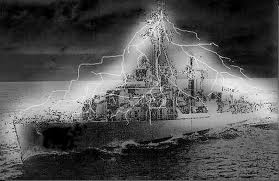
The Philadelphia experiment

It was the early hours of August 15th, 1943, the intense chill of the brisk morning air was bitter and humid, penetrating deeply into each one of us, further compounding the already heightened tensions that we were enduring at the moment. While the majority of the surrounding populous were tucked snugly underneath their warm blankets sleeping, I along with four other civilian scientists were watching many of the 176 sailors report to work on board the decks of the ship. To them, it was just another routine work day after having a well deserved night of liberty. We were on the USS Eldridge, a newly launched navy destroyer, with special authority from the U.S. Naval Department to conduct our assignments; a highly secretive scientific experiment....
After many months of preparation and planning, we had at last arrived at the final stage of the project. It was necessary for us to gut the internal confines of the Eldridge to accommodate four immense generators along with Tesla coils, electron tubes and the many miles of inch thick cable that was laid throughout the ship’s cable raceways. While watching the young sailors report on board, I remember reflecting back on the events of three days earlier, August 12th.
It was on this day, we had conducted a dry run with the Eldridge using the awesome technology developed for the sole purpose of rendering inanimate objects invisible. I could not shake from my mind the horror that I witnessed when we placed small animals in metal cages made of different materials, and strategically positioning them throughout the confines of the ship, after which, we rendered it invisible. In this experiment we had attempted to determine the effects and affects of arcing living organisms with inanimate objects. The results were disastrous!
Having mix emotions, I was disconcerted with the military’s rationale to continue on schedule knowing that they knew the potential danger, however, there was an air of excitement that overcame my scientific nature in what we were getting ready to embark upon. The military authorities in charge of the project would not take heed of our advise to delay further scheduled operations, so that we could determine what went wrong. They knew, like I knew that this schedule was based solely on a window of opportunity, and we also knew another would not be available soon. I now understood what Dr. Nikola Tesla was dealing with before his decision to leave the project. I felt confident and content with the foresight in our planning, that as long as we maintained the control of our own destiny and could pull the plug to stop the operation at any sign of trouble, all would be well. We were at an extreme disadvantage not knowing what to expect.
Experimentation up to this date had always been controlled from external sources, whereas with this one, we would have control from within the confines of the Eldridge. We had worked frantically day and night in replacing damaged equipment sustained during the dry run, just to be ready for this morning’s scheduled run. This operation had much more at stake then all of the previous experimentation put together. For myself, it was a day in my life that I realized for the first time —- I knew, what I didn’t know! The valuable time spent with Tesla prepared me for the many possibilities that this day could hold — though, I didn’t like what I heard. The dry run confirmed to me what Tesla already knew of the eminent dangers, and at the very least — I knew we were in trouble, if not damned to be damned....
Preparing to pull up anchor from the docks of the Philadelphia Naval Shipyard, the sailors seemed anxious about their next adventure at sea. It was shortly thereafter, under a cloak of darkness, that we had started our movement down the Delaware river with one small scientific research vessel following closely behind. As we moved out to sea, all heard and felt the unusual humming sound that was being emitted from the four powerful generators as they were slowly switched to higher frequencies — the vibration becoming increasingly stronger and stronger. Routine work on the Eldridge came to a complete halt as our hair now stood on end. We all felt a sense of apprehension with the uncommon electrical sensations flowing about the ship. Some men began to shake with uncontrollable fear, many others were looking cautiously about their surroundings not knowing what to think, while others tried to find comfort in their morning cup of coffee. For even the most fearless men of the ship, panic set in when men were electrocuted because they did not take heed to the instructions to stay clear from the cables that were laid out along the outer walls of the ship. Unbeknownst to the sailors who were trained only in the operation of a naval ship, for the first time were involved in an attempt to accomplish a scientific feat never before undertaken. However, they now knew this was not going to be a routine day in naval shipping.
Just prior to dawn and while out at sea, we rendered the USS Eldridge invisible by switching the generators to full strength. The men were now experiencing horrors beyond their beliefs. They were not prepared for what was to come, thus, many of the men’s minds caved and cracked. When we switched the generators to full power, it had created a strong electromagnetic field, which totally overcame and engulfed us within a heavy fog or a mist. It was at this precise moment that I sensed myself being shook violently from a strong vibration and at the same time I noted the ship disappearing from around and below me. With a generator to my back, all of a sudden as if in slow motion, I felt a tremendous impact in which I sensed my entire body being propelled outwards into hundreds of fragmented pieces. With this impact, there was a brilliant flash of light, so intense it was not only blinding, but consuming; the piercing sound forced me to the ship’s deck covering my ears with my hands in a desperate attempt to relieve the pain. Now bleeding from my mouth, nose and ears, nothing seemed to help the discomfort that I was experiencing, leaving me with the one and only thought I repeatedly recall saying to myself — “I wished I were dead”!
Eventually, these anomalies subsided and being extremely disoriented, “time” as I knew it did not seem to exist. I felt “stuck” in place, unable to move in a field of energy of total darkness. I began to realize that something had gone drastically wrong as Tesla had foreseen. Finally collecting my wits, and not allowing fear to become an overwhelming factor, I literally had to use my entire WILL and physical strength to break loose from the field of energy that encased me. Being successful in freeing myself, I was able to move about the ship taking note of many others who also were in the same predicament. There were those who were moving about in total panic, some consumed with fire and others seemed to glow. I had to reach the pilot room to locate the Captain of the ship in order to assess damages, but he too, was “stuck”. It was at this time I felt the necessity to shut down the generators to unplug the operation. The entire ship was transparent, like that of a dark red colored gelatin. Therefore, I was able to not only see through the walls of the ship, but able to move through the walls as well. An attempt made solely out of desperation, I reached through the wall for one of the generator switches —- it had no substance....
After we had rematerialized some 24 hours later and out at sea, the scene was chaotic. I was taken off the Eldridge by stretcher and immediately placed under medical sequester on board a U.S. Naval medical ship. With the sun shining brightly, I remember looking back at the horrific scene of the Eldridge still smoldering from its fires. Naval personnel were running about and working frantically to get things under control. Many of the men that were part of the rescue mission were overtaken by what they saw, and others became ill from the stench of the burning and decomposing flesh left behind for them to clean up. Things were so bad that some men from the other ships even refused to board the Eldridge. The USS Eldridge was no longer sea worthy, extremely radioactive and unstable; and of the 181 men, only 21 of us had survived. Forty men were confirmed dead as a result of radiation exposure, burns, electrocution, and fright. Twenty-seven of these 40 were men embedded within the structure of the ship, but who were not in all cases dead. Mercifully some were shot in the head using a standard military pistol, yet others were kept alive long enough for laboratory research. Lastly, the remaining 120 men were never seen from again. They were not on the Eldridge when we had returned — they were JUST GONE....
This incident that I just related to you is a personal account of my experience while on the USS Eldridge and was by no means easy to put in words. The horror and fear that every man went through is far beyond even my ability to put in words. What I personally experienced was of such a nature that I would never wish this on another. Today, many of you know this incident as the “Philadelphia Experiment”; an experiment that even to this day the U.S. government denies. In one sense this experiment worked and in another it was a failure. However, know this — where there is one failure, there are many successes!
Now, regressing a bit, the awesome technology that was used on the 15th of August, 1943, was technology that had been in the makings under Dr. Nikola Tesla’s guidance since the early 1930’s. Having had much success, the technology eventually was placed in the hands of our U.S. government and overseen by the Naval Department for national security interests. By the time our government got involved, the possibilities of the technology had already been proven beyond a doubt of its abilities.
Dr. Albert Einstein was also involved, and to a greater degree than most know. In fact, it was his “Special Theory of Relativity”, which became the theoretical cornerstone describing the release of nuclear energy, and concerns itself with relationships between energy, time, matter, and the speed of light. In his proposed “General Theory of Relativity”, he suggested that the universe is four dimensional — the three dimensions of space (length, depth and breadth) plus time. But space, instead of being flat as he had suggested in his special theory, was now curved, and that gravity was a consequence of his proposed space curvature. You see, Einstein’s general theory was so astoundingly successful that scientists world wide rapidly accepted it and who in turn after reevaluation, took their experimentation into the new direction in which Einstein had pointed. In short, Einstein vectored mankind onto a new “Timeline”! His theories made it possible for the warping, bending or the morphing of time, blackholes, traveling through time, and yes, even UFOs.
Einstein was also convinced that there was a link between the laws of electromagnetism and gravity, and that it could be expressed in a mathematical formula — known as the “Unified Field Theory”. Therefore, he himself was not thoroughly convinced that his theories of relativity explained our physical universe and/or reality in its totality. Many scientists were also out to prove Einstein wrong, one of whom was Tesla. Tesla had already conducted successful experimentation where Einstein was only on the fringes of understanding anti-gravity and anti-matter. History has been written depicting that Einstein did not live to complete his work on this theory.
I got involved with the project in 1938 and worked closely with Tesla, the government’s project director. Interviewed by a panel of men, mostly scientists, which included Tesla and some military, I was hired to work with the project primarily because of my abilities and training in physics, geometry and electronics. I was very much involved during the theorem and thorium stages and realize that we were just at the beginning stages of understanding radiation. There were numerous round-table discussions with many individuals from different walks of life and philosophies that were not only from the scientific and military communities, but also from religious and metaphysical societies. We all had our own assignments and timetables, restricting our involvement with other aspects in the development of the technology, additionally, much of the work was contracted out. It was designed so that the right hand never knew what the left hand was doing and vice versa. All issues were handled in this manner for the sole purpose of secrecy. My role also included the preparation and installation of the technology on the ship. Shortly after being with the project, I was able to distinguish the different motives by the different groups of people involved. The three key agendas that were very much part of this experimentation were:
A scientific agenda, which was to explore the time/space continuum for scientific discovery;
a military agenda, since we were at war (WW II) they wanted this ability as a weapon — to move personnel and cargo instantaneously from one point to another; and lastly,
an extraterrestrial agenda, which was to map out the earth’s planetary magnetic grid work for interdimensional travel.
However, there was a closely guarded CORE agenda by some that worked behind the scenes. I identify them as “those in the know”, and their hidden agenda was to REWRITE HISTORY....
Many Paths Pavilion- Extended Abilities area
www.spiritual-endeavors.org
The Zodiac Killer

The Zodiac Killer was a serial killer who operated in Northern California in the late 1960s. The Zodiac killer's identity remains unknown. The Zodiac killer coined the name "Zodiac" in a series of taunting letters sent to the local Bay Area press. These letters included four cryptograms (or ciphers), three of which have yet to be solved. The Zodiac murdered victims in Benicia, Vallejo, Lake Berryessa, and San Francisco between December 1968 and October 1969. Four men and three women, between the ages of 16 and 29, were targeted. Numerous suspects have been named by law enforcement and amateur investigators, but no conclusive evidence has surfaced.
In April 2004, the San Francisco Police Department marked the case "inactive", yet re-opened the case at some point prior to March 2007. The case also remains open in the city of Vallejo as well as in Napa Counties and Solano Counties.The California Department of Justice has maintained an open case file on the Zodiac murders since 1969.
Victims
Confirmed victims
Although the Zodiac claimed 37 murders in letters to newspapers, investigators agree on only seven confirmed victims, two of whom survived. They are:
David Arthur Faraday, 17, and Betty Lou Jensen, 16: shot and killed on December 20, 1968, on Lake Herman Road, within the city limits of Benicia.
Michael Renault Mageau, 19, and Darlene Elizabeth Ferrin, 22: shot on July 4, 1969, in the parking lot of Blue Rock Springs Park in Vallejo. While Mageau survived the attack, Ferrin was pronounced dead-on-arrival at Kaiser Foundation Hospital.
Bryan Calvin Hartnell, 20, and Cecelia Ann Shepard, 22: stabbed on September 27, 1969 at Lake Berryessa in Napa County. Hartnell survived six stab wounds to the back, but Shepard died as a result of her injuries on September 29, 1969.
Paul Lee Stine, 29: shot and killed on October 11, 1969, in the Presidio Heights neighborhood in San Francisco.
Suspected victims
The following murder victims are suspected to be victims of Zodiac, though none have been confirmed:
Cheri Jo Bates, 18: stabbed to death and nearly decapitated on October 30, 1966, at Riverside City College in Riverside.
Bates' possible connection to the Zodiac only appeared four years after her murder when San Francisco Chronicle reporter Paul Avery received a tip regarding similarities between the Zodiac killings and the circumstances surrounding Bates' death.
Robert Domingos, 18, and Linda Edwards, 17: shot and killed on June 4, 1966, on a beach near Lompoc. Edwards and Domingos were identified as possible Zodiac victims because of specific similarities between their attack and the Zodiac's attack at Lake Berryessa six years later.
Donna Lass, 25: last seen September 6, 1970, in Stateline, Nevada. A postcard with an advertisement from Forest Pines condominiums (near Incline Village at Lake Tahoe) pasted on the back was received at the Chronicle on 22 March 1971, and has been interpreted as the Zodiac claiming Lass' disappearance as a victim. No evidence has been uncovered to definitively connect Donna Lass' disappearance with the Zodiac Killer.
There is also a suspected third escapee from the Zodiac Killer:
Kathleen Johns, 22: allegedly abducted on March 22, 1970, on Highway 132 near I-580, in an area west of Modesto. Johns escaped from the car of a man who drove her, and her infant daughter, around in the area between Stockton and Patterson for approximately three hours.
Timeline
Lake Herman Road attack
The first murders widely attributed to the Zodiac Killer were the shootings of high school students Betty Lou Jensen and David Faraday on December 20, 1968, on Lake Herman Road, just inside Benicia city limits.
The couple were on their first date and planned to attend a Christmas concert at Hogan High about three blocks from Jensen's home. The couple, instead, visited a friend before stopping at a local restaurant, and then driving out on Lake Herman Road. At about 10:15 p.m., Faraday parked his mother's Rambler in a gravel turnout, which was a well-known lovers' lane.
Shortly after 11:00 p.m., their bodies were found by Stella Borges, who lived nearby. The Solano County Sheriff's Department investigated the crime but no leads developed.
Utilizing available forensic data, Robert Graysmith postulated that another car pulled into the turnout, just prior to 11:00 and parked beside the couple. The killer apparently exited the second car and walked toward the Rambler, possibly ordering the couple out of the Rambler. Jensen appeared to have exited the car first, yet when Faraday was halfway out, the killer apparently shot Faraday in the head. Fleeing from the killer, Jensen was gunned down twenty-eight feet from the car with five shots through her back. The killer then drove off.
Blue Rock Springs attack
Just before midnight on July 4, 1969, Darlene Ferrin and Michael Mageau drove into the Blue Rock Springs Park in Vallejo, four miles from the Lake Herman Road murder site, and parked. While the couple sat in Ferrin's car, a second car drove into the lot and parked alongside them, almost immediately driving away. Returning about 10 minutes later, this second car parked behind them. The driver of the second car then exited the vehicle, approaching the passenger side door of Ferrin's car, carrying a flashlight and a 9 mm Luger. First, the killer directed the flashlight into Mageau's and Ferrin's eyes, before shooting each of the victims 3 times. When Mageau moaned in pain, the killer returned and shot each victim 2 more times before driving off.
On July 5, 1969, at 12:40 a.m., a man phoned the Vallejo Police Department to report and claim responsibility for the attack. He also took credit for the murders of Jensen and Faraday six-and-a-half months earlier. The police traced the call to a phone booth at a gas station at Springs Road and Tuolumne, about three-tenths of a mile from Ferrin's home and only a few blocks from the Vallejo Police Department.
Ferrin was pronounced dead at the hospital. Mageau survived the attack despite being shot in the face, neck, and chest.
The Zodiac letters begin
On August 1, 1969, three letters prepared by the killer were received at the Vallejo Times-Herald, the San Francisco Chronicle, and the San Francisco Examiner. The nearly identical letters took credit for the shootings at Lake Herman Road and Blue Rock Springs. Each letter also included one-third of a 408-symbol cryptogram which the killer claimed contained his identity. The killer demanded they be printed on each paper's front page or he would "cruse [sic] around all weekend killing lone people in the night then move on to kill again, until I end up with a dozen people over the weekend." The Chronicle published its third of the cryptogram on page four of the next day's edition. An article printed alongside the code quoted Vallejo Police Chief Jack E. Stiltz as saying "We're not satisfied that the letter was written by the murderer" and requested the writer send a second letter with more facts to prove his identity. The threatened murders did not happen, and all three parts were eventually published.
On August 7, 1969, another letter was received at the San Francisco Examiner with the salutation "Dear Editor This is the Zodiac speaking". It was the first time the killer had referred to himself with this name. The letter was in response to Chief Stiltz asking him to provide more details to prove he killed Faraday, Jensen and Ferrin. In it, the Zodiac included details about the murders which had not been released to the public as well as a message to the police that when they cracked his code "they will have me".
On August 8, 1969, Donald and Bettye Harden of Salinas, California, cracked the 408-symbol cryptogram. No name appears in the decoded text.
Lake Berryessa Attack
On September 27, 1969, Bryan Hartnell and Cecelia Shepard were picnicking at Lake Berryessa on a small island connected by a sand spit to Twin Oak Ridge. A man approached them wearing a black executioner's-type hood with clip-on sunglasses over the eye-holes and a bib-like device on his chest that had a white 3"x3" cross-circle symbol on it. He approached them with a gun which Hartnell believed to be a .45. The hooded man claimed to be an escaped convict from Deer Lodge, Montana; where he killed a guard and stole a car, explaining that he needed their car and money to go to Mexico. He had brought precut lengths of plastic clothesline and told Shepard to tie up Hartnell, before he tied her up. The killer checked, and tightened, Hartnell's bonds after discovering Shepard had bound Hartnell's hands loosely. Hartnell initially believed it to be a weird robbery, but the man drew a knife and stabbed them both repeatedly. The killer then hiked 500 yards back up to Knoxville Road, drew the cross-circle symbol on Hartnell's car door with a black felt-tip pen, and wrote beneath it: "Vallejo/12-20-68/7-4-69/Sept 27-69-6:30/by knife."
At 7:40 p.m., the killer called the Napa County Sheriff's office from a pay telephone to report his crime. The phone was found, still off the hook, minutes later at the Napa Car Wash on Main Street in Napa by KVON radio reporter Pat Stanley, only a few blocks from the sheriff's office, yet 27 miles from the crime scene. Detectives were able to lift a still-wet palm print from the telephone but were never able to match it to any suspect.
After hearing their screams for help, a man and his son who were fishing in a nearby cove discovered the victims and summoned help by contacting park rangers. Napa County Sheriff's deputies Dave Collins and Ray Land were the first law enforcement officers to arrive at the crime scene. Cecelia Shepard was conscious when Collins arrived, providing him with a detailed description of the attacker. Hartnell and Shepard were taken to Queen of the Valley Hospital in Napa by ambulance. Shepard lapsed into a coma during transport to the hospital and never regained consciousness. She died two days later, but Hartnell survived to recount his tale to the press. Napa County Sheriff Detective Ken Narlow, who was assigned to the case from the outset, worked on solving the crime until his retirement from the department in 1987.
Presidio Heights attack
On October 11, 1969, a man entered the cab driven by Paul Stine at the intersection of Mason and Geary Streets in San Francisco requesting to be taken to Washington and Maple Streets in Presidio Heights. For reasons unknown, Stine drove one block past Maple to Cherry Street; this passenger then shot Stine once in the head with a 9 mm, took Stine's wallet, car keys, and tore away a section of Stine's bloodstained shirt tail. He was observed by three teenagers across the street at 9:55 p.m., who called the police while the crime was in progress. They observed the man wiping the cab down before walking away towards the Presidio, one block to the north.
Two blocks from the crime scene, Officer Don Fouke, responding to the call, observed a white man walking along the sidewalk stepping onto a stairway leading up to the front yard of one of the homes on the north side of the street; the encounter lasted only five to ten seconds. The radio dispatcher had alerted to be on the lookout for a black suspect, so they drove past him without stopping; the mix-up in descriptions remains unexplained to this day. A search ensued, but no possible suspects were found. The three teen witnesses worked with a police artist to prepare a composite sketch of Stine's killer; then, a few days later, this police artist returned, working with the witnesses to prepare a second composite sketch of the killer.
Detectives Bill Armstrong and Dave Toschi were assigned to the case.
The San Francisco Police Department investigated an estimated 2,500 suspects over a period of years.
Prime suspect
Arthur Leigh Allen
Arthur Leigh Allen was the prime suspect in the Zodiac murders and the only suspect served search warrants by police. He was never charged with any Zodiac-related crime, and his fingerprints did not match those left by the killer of taxi cab driver Paul Stine. In 1992, twenty-three years after the shootings, survivor Michael Mageau identified Allen as the man who shot him, from a photo lineup of 1968 driver's license photos. Allen, who suffered from diabetes, died in 1992 from kidney failure. In 2002, DNA samples taken from saliva on the Zodiac's stamps and envelopes were compared with the DNA of Arthur Leigh Allen, and the DNA of a former close friend of Allen named Don Cheney, who first identified Allen as the Zodiac Killer. Allen and Cheney were ruled out as the contributors of the DNA, though it cannot be stated definitively that it is DNA from the Zodiac on the envelopes.
The Voynich manuscript

The Voynich manuscript is a handwritten book thought to have been written in the 15th or 16th century and comprising about 240 vellum pages, most with illustrations. The author, script, and language remain unknown: for these reasons it has been described as "the world's most mysterious manuscript".
Generally presumed to be some kind of ciphertext, the Voynich manuscript has been studied by many professional and amateur cryptographers, including American and British codebreakers from both World War I and World War II. Yet it has defied all decipherment attempts, becoming a historical cryptology cause célèbre. The mystery surrounding it has excited the popular imagination, making the manuscript a subject of both fanciful theories and novels: numerous possible authors have been suggested for it.
In 2009, University of Arizona researchers performed C14 dating on the manuscript's vellum, which they assert (with 95% confidence) was made between 1404 and 1438. In addition, the McCrone Research Institute in Chicago found that much of the ink was added not long afterwards, confirming that the manuscript is indeed an authentic medieval document. However, these results have yet to be published properly, leaving room for continued speculation.
The book is named after the Polish-Lithuanian-American book dealer Wilfrid M. Voynich, who acquired it in 1912. Currently the Voynich manuscript is owned by the Beinecke Rare Book and Manuscript Library of Yale University, and is formally referred to as "Beinecke MS 408". The first facsimile edition was published in 2005.
Content
Text
The manuscript's quires are numbered from 1 to 20, its folios (some with unusual fold-out shapes) are numbered from 1 to 116, yielding a total (depending on how you choose to count them) of 240 vellum pages. From the various numbering gaps, it seems likely that the manuscript originally had at least 272 pages: the remaining pages were already missing when Voynich acquired it in 1912. A quill pen was used for the text and figure outlines, and colored paint was applied (somewhat crudely) to the figures, possibly at a later date. There is strong evidence that many of the book's bifolios were reordered at various points in its history, and that the original page order may well have been quite different to what we see today.
The text was clearly written from left to right, with a slightly ragged right margin. Longer sections are broken into paragraphs, sometimes with star- or flower-like "bullets" in the left margin. There is no obvious punctuation. The ductus flows smoothly, giving the impression that the symbols were not enciphered, for if that were so the individual characters would have had to be calculated before being written. However, it is possible to write somewhat fluently in other codes or private shorthands, or when copying prepared text from a wax tablet.
The text consists of over 170,000 discrete glyphs, usually separated from each other by narrow gaps. Most of the glyphs are written with one or two simple pen strokes. While there is some dispute as to whether certain glyphs are distinct or not, an alphabet with 20–30 glyphs would account for virtually all of the text; the exceptions are a few dozen rarer characters that occur only once or twice each.
Wider gaps divide the text into about 35,000 "words" of varying length. These seem to follow phonetic or orthographic laws of some sort e.g. certain characters must appear in each word (like English vowels), some characters never follow others, some may be doubled or tripled but others may not, etc.
Statistical analysis of the text reveals patterns similar to those of natural languages. For instance, the word entropy (about 10 bits per word) is similar to that of English or Latin texts. Some words occur only in certain sections, or in only a few pages; others occur throughout the manuscript. There are very few repetitions among the thousand or so "labels" attached to the illustrations. In the herbal section, the first word on each page occurs only on that page and may possibly be the name of the plant.
On the other hand, the Voynich manuscript's "language" is quite unlike European languages in several aspects. Firstly, there are practically no words comprising more than ten glyphs, yet there are also few one- or two-letter words. The distribution of letters within words is also rather peculiar: some characters only occur at the beginning of a word, some only at the end, and some always in the middle section. While Semitic alphabets have many letters that are written differently depending on whether they occur at the beginning, in the middle or at the end of a word, letters of the Latin, Cyrillic and Greek alphabets are generally written the same way regardless of their position within a word (with the Greek letter sigma and the medieval scribal 's' being notable exceptions).
The text seems to be more repetitive than typical European languages; there are instances where the same common word appears up to three times in a row. Words that differ only by one letter also repeat with unusual frequency, causing single substitution alphabet decipherments to yield babble-like text. According to Elizebeth Friedman, such attempts are "doomed to utter frustration."
There are only a few words in the manuscript written in a seemingly Latin script. On the last page, there are four lines of writing that are written in (rather distorted) Latin letters, except for two words in the main script. The lettering resembles European alphabets of the late 14th and 15th centuries, but the words do not seem to make sense in any language.Also, a series of diagrams in the "astronomical" section has the names of ten of the months (from March to December) written in Latin script, with spelling suggestive of the medieval languages of France, North West Italy or the Iberian Peninsula. However, it is not known whether these bits of Latin script were part of the original text or were added later.
Illustrations
The illustrations of the manuscript shed little light on the precise nature of its text but imply that the book consists of six "sections", with different styles and subject matter. Except for the last section, which contains only text, almost every page contains at least one illustration. Following are the sections and their conventional names:
Herbal. Each page displays one plant (sometimes two) and a few paragraphs of text—a format typical of European herbals of the time. Some parts of these drawings are larger and cleaner copies of sketches seen in the "pharmaceutical" section (below). None of the plants depicted are unambiguously identifiable.[citation needed]
Astronomical. Contains circular diagrams, some of them with suns, moons, and stars, suggestive of astronomy or astrology. One series of 12 diagrams depicts conventional symbols for the zodiacal constellations (two fish for Pisces, a bull for Taurus, a hunter with crossbow for Sagittarius, etc.). Each of these has 30 women figures arranged in two or more concentric bands. Most of the females are at least partly naked, and each holds what appears to be a labeled star or is shown with the star attached by what could be a tether or cord of some kind to either arm. The last two pages of this section (Aquarius and Capricornus, roughly January and February) were lost, while Aries and Taurus are split into four paired diagrams with 15 women and 15 stars each. Some of these diagrams are on fold-out pages.
Biological. A dense continuous text interspersed with figures, mostly showing small naked women bathing in pools or tubs connected by an elaborate network of pipes, some of them clearly shaped like body organs. Some of the women wear crowns.
Cosmological. More circular diagrams, but of an obscure nature. This section also has foldouts; one of them spans six pages and contains a map or diagram, with nine "islands" connected by "causeways", castles, and what may be a volcano.
Pharmaceutical. Many labeled drawings of isolated plant parts (roots, leaves, etc.); objects resembling apothecary jars drawn along the margins; and a few text paragraphs.
Recipes. Many short paragraphs, each marked with a flower- or star-like "bullet".
Multiple authors
Prescott Currier, a US Navy cryptographer who worked with the manuscript in the 1970s, observed that the pages of the "herbal" section could be separated into two sets, A and B, with distinctive statistical properties and apparently different handwritings. He concluded that the Voynich manuscript was the work of two or more authors who used different dialects or spelling conventions, but who shared the same script. However, recent studies have questioned this conclusion. Also, when all sections are examined, one sees a more gradual transition, with herbal A and herbal B at opposite ends. Thus, Currier's observations could simply be the result of the herbal sections being written by one author over a long period of time.
Language
There are many theories about the Voynich manuscript's "language":
Ciphers
Micrography
Steganography
Exotic natural language
Glossolalia
Hybrid language
Constructed language
Furthter details: http://www.isi.edu/natural-language/people/voynich.pdf
Black Dahlia

Elizabeth Short (July 29, 1924 – ca. January 15, 1947) was an American woman and the victim of a gruesome and much-publicized murder. She acquired the moniker The Black Dahlia posthumously by newspapers in the habit of nicknaming crimes they found particularly colorful. Short was found mutilated, her body severed at the waist, on January 15, 1947, in Leimert Park, Los Angeles, California. Short's unsolved murder has been the source of widespread speculation along with several books and film adaptations.
Murder and aftermath
The body of Elizabeth Short was found on January 15, 1947, in a vacant lot located in the Leimert Park area of Los Angeles near 39th Street and Norton Avenue. The body was discovered by housewife Betty Bersinger, who was walking with her three-year-old daughter Her severely mutilated body had been severed at the waist and drained of blood] and her face was slashed from the corners of her mouth toward her ears. She had been "posed" with her hands over her head and elbows bent at right angles.The autopsy stated Short was 5 feet 5 inches (1.65 m), weighed 115 pounds (52 kg), and had light blue eyes, brown hair, and badly decayed teeth.
Short was buried at the Mountain View Cemetery in Oakland, California. After her other sisters had grown and married, Short's mother moved to Oakland to be near her daughter's grave. Phoebe Short finally returned to the East Coast in the 1970s and lived into her nineties.
Rumors and popular misconceptions
According to newspaper reports shortly after the murder, Elizabeth Short received the nickname "Black Dahlia" at a Long Beach drugstore in the summer of 1946, as a word play on the then-current movie The Blue Dahlia. Los Angeles County district attorney investigators' reports state, however, that the nickname was invented by newspaper reporters covering the murder. Los Angeles Herald-Express reporter Bevo Means, who interviewed Short's acquaintances at the drug store, is credited with first using the "Black Dahlia" name.
A number of people, none of whom knew Short, contacted police and the newspapers claiming to have seen her during her so-called "missing week"—a time period between the time of her January 9 disappearance and the time her body was found on January 15. Police and district attorney investigators ruled out each of these alleged sightings, wherein, in some cases, those interviewed were identifying other women they had mistaken for Short.
Many "true crime" books claim that Short lived in or visited Los Angeles at various times in the mid 1940s; these claims have never been substantiated and are refuted by the findings of law enforcement officers who investigated the case. A document in the Los Angeles County district attorney's files titled "Movements of Elizabeth Short Prior to June 1, 1946" states that Short was in Florida and Massachusetts from September 1943 through the early months of 1946 and gives a detailed account of her living and working arrangements during this period. Although a popular portrayal amongst her acquaintances and many true crime authors was of Short as a call girl, the Los Angeles district attorney's grand jury proved there was no existing evidence that she was ever a prostitute. Another widely circulated rumor holds that Short was unable to have sexual intercourse because of a congenital defect that left her with "infantile genitalia."
Los Angeles County district attorney's files state that the investigators had questioned three men with whom Short had sex, including a Chicago police officer who was a suspect in the case.The FBI files on the case also contain a statement from one of Short's alleged lovers. Found in the Los Angeles district attorney's files and in the Los Angeles Police Department's summary of the case, Short's autopsy describes her reproductive organs as anatomically normal. The autopsy also states that Short was not and had never been pregnant, contrary to what had been claimed prior to and following her death.
Suspects
At the time, the Black Dahlia murder investigation was the largest LAPD investigation since the murder of Marion Parker in 1927. Because of the size of the investigation, the case also enlisted the help of hundreds of officers borrowed from other law enforcement agencies. Because of the complexity of the case, the original investigators treated every person who knew Short with suspicion until eliminated as a suspect. Hundreds of people were considered suspects and thousands were interviewed by police. Owing to the nature of the crime, sensational and sometimes inaccurate press coverage focused intense public attention on the case. Most of the approximately 60 people who confessed to the murder were men.
Theories and possible related murders
Some crime authors have speculated on a link between the Short murder and the Cleveland Torso Murders, which took place in Cleveland between 1934 and 1938.As with a large number of killings that took place before and after the Short murder, the original LAPD investigators looked into the Cleveland murders in 1947 and discounted any relationship between the two cases. The LAPD continued to look for similarities in other murder cases for possible connections well into the 1950s.
Crime authors such as Steve Hodel have suggested a link between the Short murder and the 1946 murder and dismemberment of six-year-old Suzanne Degnan in Chicago.Among the evidence cited is the fact that Elizabeth Short's body was found on Norton Avenue three blocks west of Degnan Boulevard, Degnan being the last name of the girl from Chicago. Currently, convicted serial killer William Heirens is serving time for Degnan's murder. Initially arrested at age 17 for breaking into a residence close to that of Suzanne Degnan, Heirens claims he was tortured by police, forced to confess, and made a scapegoat in the Degnan murder.
The 'bloop'
You can hear the bloop here -> http://en.wikipedia.org/wiki/File:Bloop.ogg
Analysis
The sound, traced to somewhere around 50° S 100° W (a remote point in the south Pacific Ocean west of the southern tip of South America), was detected repeatedly by the Equatorial Pacific Ocean autonomous hydrophone array, which uses U.S. Navy equipment originally designed to detect Soviet submarines.
According to the NOAA description, it "rises rapidly in frequency over about one minute and was of sufficient amplitude to be heard on multiple sensors, at a range of over 5,000 km." The NOAA's Dr. Christopher Fox does not believe its origin is human, such as a submarine or bomb, nor familiar geological events such as volcanoes or earthquakes. While the audio profile of the bloop does resemble that of a living creature, the source is a mystery both because it is different from known sounds and because it was far too loud: it was several times louder than the loudest known biological sound. Five other significant unexplained sounds have been named by NOAA: Julia, Train, Slowdown, Whistle, and Upsweep.
Dr. Christopher Fox of the NOAA speculated that the Bloop may be ice calving in Antarctica. A year later Dr. Fox was paraphrased speculating it was likely animal in origin.
In popular culture
In an alternate reality game promoting the movie, the Bloop was linked to the monster from Cloverfield.
In The Loch by Steve Alten, the Bloop is the call of an undiscovered species of giant eel.
In Fluke, or, I Know Why the Winged Whale Sings by Christopher Moore, the source of the Bloop is a living colony known as the "Goo".
In Frank Schätzing's novel The Swarm, the Bloop is the speech of the intelligent species, the Yrr.
People have pointed out that the location of the sound originated within 500 miles from the location of R'lyeh in the South Pacific, thus coincidentally linking the sound to the sleeping, Great Old One Cthulhu in the fiction of H.P. Lovecraft.
The Hum

The ‘Taos Hum’ is a low-pitched sound heard in numerous places worldwide, especially in the USA, UK, and northern europe. It is usually heard only in quiet environments, and is often described as sounding like a distant diesel engine. Since it has proven indetectable by microphones or VLF antennae, its source and nature is still a mystery.
In 1997 Congress directed scientists and observers from some of the most prestigious research institutes in the nation to look into a strange low frequency noise heard by residents in and around the small town of Taos, New Mexico. For years those who had heard the noise, often described by them as a “hum”, had been looking for answers. To this day no one knows the cause of the hum.
The Hum is sometimes prefixed with the name of a locality where the problem has been particularly publicized: e.g., the "Bristol Hum", the "Taos Hum" or the "Bondi Hum".
Description
The essential element that defines the Hum is what is perceived as a persistent low-frequency sound, often described as being comparable to that of a distant diesel engine idling, or to some similar low-pitched sound for which obvious sources (e.g., household appliances, traffic noise, etc.) have been ruled out.
Other elements seem to be significantly associated with the Hum, being reported by an important proportion of hearers, but not by all of them. Many people hear the Hum only, or much more, inside buildings as compared with outdoors. Many also perceive vibrations that can be felt through the body. Earplugs are reported as not decreasing the Hum. The Hum is often perceived more intensely during the night.
In the Unsolved Mysteries segment called "Mystery Hum", a tape re-creation of the Taos Hum was used for this segment. Robert Stack reported that one of the "Hum sufferers" created the audio tape, mainly for the purpose in that particular segment. This was done since their audio equipment didn't pick up low-frequency sounds very well, and so that the show's viewers and other non-"Hum sufferers" would get an idea of what the actual auditory phenomenon sounded like.
On 15 November 2006, Dr. Tom Moir of the University of Massey in Auckland, New Zealand made a recording of the Auckland Hum and has published it on the university's website.The captured hum's power spectral density peaks at a frequency of 56 hertz. In 2009, the head of audiology at Addenbrooke's Hospital in Cambridge, Dr. David Baguley said that he believed people's problems with hum were based on the physical world about one-third of the time and the other two-thirds stemmed from people focusing too keenly on innocuous background sounds.
History
It was during the 1990s that the Hum phenomenon began to be reported in North America and to be known to the American public, when a study by the University of New Mexico and the complaints from many citizens living near the town of Taos, New Mexico, caught the attention of the media. However, in the 1970s and 1980s, a similar phenomenon had been the object of complaints from citizens, of media reports and of studies. It is difficult to tell if the Hum reported in those earlier cases and the Hum that began to be increasingly reported in North America in the 1990s should be considered identical or of different natures. During the last decade, the Hum phenomenon has been reported in many other cities and regions in North America and Europe and in some other regions of the world.
In the case of Kokomo, Indiana, a city with heavy industries, the source of the hum was thought to have been traced to two sources. The first was a pair of fans in a cooling tower at the local DaimlerChrysler casting plant emitting a 36 Hz tone. The second was an air compressor intake at the Haynes International plant emitting a 10 Hz tone.
Some other possible explanations
-Tinnitus
-Spontaneous otoacoustic emissions
-Colliding ocean waves
Mary Celeste

The Mary Celeste (often incorrectly referred to as Marie Celeste) was a brigantine merchant ship notably discovered in December 1872 in the Atlantic Ocean unmanned and apparently abandoned, despite the fact that the weather was fine and her crew had been experienced and able seamen. The Mary Celeste was in seaworthy condition and still under sail heading towards the Strait of Gibraltar. She had been at sea for a month and had over six months' worth of food and water on board. Her cargo was virtually untouched and the personal belongings of passengers and crew were still in place, including valuables. The crew was never seen or heard from again. Their disappearance is often cited as the greatest maritime mystery of all time.
The fate of her crew has been the subject of much speculation. Theories range from alcoholic fumes, to underwater earthquakes, to waterspouts, to paranormal explanations involving hypothetical extraterrestrial, unidentified flying objects, sea monsters, and the hypothetical phenomena of the Bermuda Triangle, although the Mary Celeste is not known to have sailed through the Bermuda Triangle area. The Mary Celeste is often described as the archetypal ghost ship, since she was discovered derelict without any apparent explanation, and her name has become a synonym in British culture for similar occurrences.
!THEORIES !
Piracy
One reporter suggested that the Mary Celeste may have fallen victim to an act of piracy, the crew murdered and thrown overboard, as Ottoman pirates had been known to operate in the area.
This is extremely unlikely. There had been no reports of piracy in the waters around the Azores or the Straits of Gibraltar for decades, most likely due to Britain's Royal Navy station at Gibraltar. No piracy attacks were reported in the area at the time. Moreover, there were no signs of violence on the Mary Celeste and only common navigation equipment was missing; it is unlikely that pirates would fail to remove the cargo or the crew's valuables after killing the crew.
The crew of the Dei Gratia as suspects
Some writers suggest that the crew of the Dei Gratia murdered those on board and then fabricated the story of the ghost ship to secure the salvage rights. However, once again there was no sign of struggle and nothing of value had been taken. When the Dei Gratia presented the Mary Celeste to the British authorities in Gibraltar, the ship was intact and her manifests and inventories full and accounted for.
Further, the captain of the Dei Gratia was an old friend of Captain Briggs, which makes his murdering Briggs, his wife and their two-year-old daughter unlikely. The Mary Celeste sailed one week before the Dei Gratia and Moorehead would not have been able to overtake the Mary Celeste. The Court Inquiry praised the crew of the Dei Gratia for their courage and seamanship in effecting the salvage.
Insurance fraud
Insurance fraud has been cited as a possible explanation. This requires that Briggs and Morehouse colluded and that Captain Briggs assumed a new identity. However, the insurance premium to be paid was not a great amount of money. Moreover, the ship belonged mainly to James Winchester, not Benjamin Briggs. A staged incident would have required much risk for a very modest profit.
Storm
The Mary Celeste may have encountered a storm. Perhaps water began to flood the ship and the crew left in the lifeboat, thinking the Mary Celeste was sinking. When she was discovered, two of her three water pumps had been disassembled. She was sailing with a much larger quantity of water in the bilge than usual, but it was hardly enough to make Briggs order evacuation, although it could be argued that the presence of his wife and daughter made him unusually cautious.
Unfortunately for this theory, no storms were reported in the area at the time, only mildly choppy weather. The waters were calm when the Mary Celeste was discovered. A storm did hit later, when the Dei Gratia was sailing to Gibraltar, and there is a possibility that the Mary Celeste was hit by freak weather conditions.
Seaquake
An explanation offered by a modern sailor, Captain David Williams, who encountered earthquakes at sea, is that a seaquake erupted below the ship and jarred open nine barrels of alcohol (~450 gallons) which leaked into the bilge. The earthquake also dislodged the fuel for the hot stove on deck and caused embers from the fire to drift into the rigging. Williams suggests this caused the crew to panic and abandon the ship and the Mary Celeste sailed on without the crew. The crew then decided to try to catch her in the small sailing dingy, but did not succeed and died at sea. Seismic activity is indeed common in the area, and this theory has been cited frequently.Notwithstanding, the log made no mention of underwater rumblings, nor did the crew of the Dei Gratia report any tremors or aftershocks, nor did any other vessel in the area. Most importantly, the inhabitants of the nearby Portuguese islands of the Azores did not report any rumblings.
Tidal Wave
Another theory is that a tidal wave was caused by an earthquake or perhaps a landslide in the Canary Islands or the Azores. The crew may have been washed overboard or a giant oncoming wave may have scared them into evacuation. This would have explained why the Mary Celeste had taken on so much water. Again, no tidal wave, earthquake or landslide was reported either on land or at sea. Tidal waves are relatively unnoticeable in deep water and do not present a threat to shipping, and only become dangerous as they approach the shoreline. This theory would also require passengers and crew to have been on deck at the time. However, a rogue wave might be a plausible explanation.
Waterspout
A similar scenario is that the ship encountered a waterspout, a tornado-like storm with a funnel cloud that occurs at sea. The water surrounding the ship may, in being sucked upwards, have given the impression that the Mary Celeste was sinking.[citation needed] This would explain why the Mary Celeste was soaking wet when discovered by the crew of the Dei Gratia. A mass panic among the crew would probably explain the scratched railing and the broken compass, as well as the missing lifeboat.
Lower air pressure resulting from a waterspout might have thrown off measurements of how deep the water level was in the ship's hull. A dipstick-like device was used to monitor water levels in the bilge. Low pressure could pull water up the tube around the stick, creating the impression of a sinking vessel. This explanation was first put forth by Dr. James H. Kimble and author Gersholm Bradford. Although unlikely, it is still one of the most logical theories put forward.
Ergotamine
Yet another theory claims that ergotamine sometimes found in ergot fungus from possibly contaminated flour aboard the ship and had serious effects of ergotism on the crew. Ergotamine in large quantities can have similar hallucinogenic effects to LSD, and can also cause immense pain in instances of both convulsive symptoms and gangrenous symptoms, ultimately resulting in them perhaps losing their sanity and murder, or them throwing themselves overboard. Mania, delusions, psychosis and suicidal tendencies can be caused by eating such fungus. However, this theory seems very unlikely since high doses are usually needed and usually over some time. Most importantly, the flour aboard the Mary Celeste was not stated as being contaminated; in fact, quite the opposite, it was said to be fine, and the sailors from the Dei Gratia were not affected after eating it.
Mutiny
Another theory has suggested there was a mutiny among the crew who murdered a tyrannical Briggs and his family, then escaped in the lifeboat. This theory is strongly discredited by the fact Briggs had no "tyrannical" history to suggest he was the type of captain to provoke his crew to mutiny. By all accounts, he was well respected, fair and able. First Mate Albert Richardson and the rest of the crew also had excellent reputations and were experienced, loyal seamen.
Drunkenness amongst the crew
After the admiralty court proceeding, Solly-Flood QC proposed that the crew, after consuming the alcohol from the kegs that were recovered empty, murdered the Briggs family in a drunken stupor. The mutinous crew are then presumed to have deliberately damaged the vessel to give the illusion of having been forced to abandon it, then they would have left in lifeboats.
However, the captain was a believer in abstinence and unlikely to tolerate drinking on board or a crew inclined to drink alcohol. Besides, in the raw form in which the alcohol was transported, consumption without proper preparations would have caused irreparable physical damage to its consumers instead of intoxicating them. Finally, there was no trace of struggle or violence aboard the vessel, and the crew had good records. But still, theri dissapearance remains an unsolved mystery.
Holy Grail

The Holy Grail is a sacred object figuring into literature and certain Christian traditions, most often identified with the dish, plate, or cup used by Jesus at the Last Supper and said to possess miraculous powers. The connection of Joseph of Arimathea with the Grail legend dates from Robert de Boron's Joseph d'Arimathie (late 12th century) in which Joseph receives the Grail from an apparition of Jesus and sends it with his followers to Great Britain; building upon this theme, later writers recounted how Joseph used the Grail to catch Christ's blood while interring him and that in Britain he founded a line of guardians to keep it safe. The quest for the Holy Grail makes up an important segment of the Arthurian cycle, appearing first in works by Chrétien de Troyes. The legend may combine Christian lore with a Celtic myth of a cauldron endowed with special powers.
The development of the Grail legend has been traced in detail by cultural historians: It is a legend which first came together in the form of written romances, deriving perhaps from some pre-Christian folklore hints, in the later 12th and early 13th centuries. The early Grail romances centered on Percival and were woven into the more general Arthurian fabric. Some of the Grail legend is interwoven with legends of the Holy Chalice.
The Grail was considered a bowl or dish when first described by Chrétien de Troyes. Hélinand of Froidmont described a grail as a "wide and deep saucer" (scutella lata et aliquantulum profunda). Other authors had their own ideas: Robert de Boron portrayed it as the vessel of the Last Supper; and Peredur had no Grail per se, presenting the hero instead with a platter containing his kinsman's bloody, severed head. In Parzival, Wolfram von Eschenbach, citing the authority of a certain (probably fictional) Kyot the Provençal, claimed the Grail was a stone that fell from Heaven (called lapsit exillis), and had been the sanctuary of the Neutral Angels who took neither side during Lucifer's rebellion. The authors of the Vulgate Cycle used the Grail as a symbol of divine grace. Galahad, illegitimate son of Lancelot and Elaine, the world's greatest knight and the Grail Bearer at the castle of Corbenic, is destined to achieve the Grail, his spiritual purity making him a greater warrior than even his illustrious father. Galahad and the interpretation of the Grail involving him were picked up in the 15th century by Sir Thomas Malory in Le Morte d'Arthur, and remain popular today
Dan Brown's bestselling novel The Da Vinci Code, which, like Holy Blood, Holy Grail, is based on the idea that the real Grail is not a cup but the womb and later the earthly remains of Mary Magdalene (again cast as Jesus' wife), plus a set of ancient documents telling the "true" story of Jesus, his teachings and descendants. In Brown's novel, it is hinted that Jesus was merely a mortal man with strong ideals, and that the Grail was long buried beneath Rosslyn Chapel in Scotland, but that in recent decades its guardians had it relocated to a secret chamber embedded in the floor beneath the Inverted Pyramid near the Louvre Museum. The latter location, like Rosslyn Chapel, has never been mentioned in real Grail lore
Read more on: http://en.wikipedia.org/
Ghosts

Ghost, nonmaterial embodiment or essence of an organism, especially of a human being. The term is sometimes used virtually as a synonym for soul or spirit, and in the Christian religion, in the form Holy Ghost (now, more often, Holy Spirit), it has a specialized meaning.
More frequently, however, the term ghost is applied to an apparition, usually of a dead person, that varies in apparent solidity from a mere foglike mass to a perfect replica of the person. A wraith, in contrast, is the visible spirit of someone still alive.
A doppelgänger is a special form of wraith that makes its appearance at a time when the physical body of the subject is observed at some distant place.
In many religions, and particularly in primitive faiths, the belief exists that the spirit wanders away from the body during periods of unconsciousness such as sleep. Such religions also teach that after death the spirit lingers near the body of the dead person. A common practice of groups holding such beliefs is to propitiate the ghosts of the dead by offerings of food, clothing, and other objects that the ghosts may find useful in the spirit world. In many primitive civilizations the personal possessions of a dead man, including his weapons, his pets, and sometimes even his wife, are buried or burned with his body. The practice of ancestor worship, as well as the mourning rites of many modern civilizations, probably originated in the belief in ghosts.
Did you see a ghost?
D.B.Cooper

D. B. Cooper is the name attributed to a man who hijacked a Boeing 727 aircraft in the United States on 24 November 1971, received US $ 200,000 in ransom, and parachuted from the plane. The name he used to board the plane was Dan Cooper, but through a later press miscommunication, he became known as "D. B. Cooper". Despite hundreds of leads through the years, no conclusive evidence has ever surfaced regarding Cooper's true identity or whereabouts, and the bulk of the money has never been recovered. Several theories offer competing explanations of what happened after his famed jump, but the FBI believes he did not survive.
The nature of Cooper's escape and the uncertainty of his fate continue to intrigue people. The Cooper case (code-named "Norjak" by the FBI) is the only unsolved U.S. aircraft hijacking, and one of the few such cases anywhere in the world, along with Malaysia Airlines Flight 653.
The Cooper case has baffled government and private investigators for decades, with countless leads turning into dead ends. As late as March 2008, the FBI thought it might have had a breakthrough when children unearthed a parachute within the bounds of Cooper's probable jump site near the town of Amboy, Washington. Experts later determined that it did not belong to the hijacker.
Despite the case's enduring lack of evidence, a few significant clues have arisen. In late 1978 a placard containing instructions on how to lower the aft stairs of a 727, later confirmed to be from the rear stairway of the plane from which Cooper jumped, was found just a few flying minutes north of Cooper's projected drop zone. In February 1980 on the banks of the Columbia River, eight-year-old Brian Ingram found $5,880 in decaying $20 bills, which proved to be part of the original ransom.
In October 2007, the FBI claimed that it had obtained a partial DNA profile of Cooper from the tie he left on the hijacked plane. On December 31, 2007, the FBI revived the unclosed case by publishing never-before-seen composite sketches and fact sheets online in an attempt to trigger memories that could possibly identify Cooper. In a press release, the FBI reiterated that it does not believe Cooper survived the jump, but expressed an interest in ascertaining his identity.
Any clues about D.B.Cooper? post them bellow this post.
The Creation of Man

This is probably one of the most well known and controversial of mysteries known to man at the moment. The basic mystery is where did we come from? Many people believe we were created by some kind of God, others believe were naturally came into being through the process of evolution, and some even believe we were put onto earth by aliens. Because there is no conclusive evidence for either argument, this subject remains our greatest mystery.
The concept of evolution states that through a series of adaptations and mutations from generation to generation, a creature can change dramatically over time. There are many arguments against evolution, mostly (in the West) from fundamentalist Christian bodies. The head of the largest Christian Church, Pope Benedict XVI, has recently said that evolution is not contrary to the teachings of the Church or a belief in God as long as it does not exclude God as the primary mover and organiser of the process.
The concept of creationism states that God made the Universe in the form in which it exists today. It attempts to explain away potential theological problems like dinosaurs, carbon dating, and the fossil record in general. Creationists generally believe the earth to be several thousand years old.
ISLAM TEACHINGS
The descriptions of creation in the Qur'an are not intended as dry historical accounts, but rather to engage the reader in contemplating the lessons to be learned from it. The act of creation, therefore, is frequently spoken of as a way of drawing the reader into thinking about the order in all things, and the All-Knowing Creator Who is behind it all. For example:
"Verily in the heavens and the earth are signs for those who believe. And in the creation of yourselves, and the fact that animals are scattered (through the earth), are signs for those of assured faith. And in the alternation of night and day, and that fact that Allah sends down sustenance from the sky, and revives therewith the earth after its death, and in the change of the winds, are signs for those who are wise" (45:3-5).
Big Bang?
When describing the creation of the "heavens and the earth," the Qur'an does not discount the theory of a "Big Bang" explosion at the start of it all. In fact, the Qur'an says that "the heavens and the earth were joined together as one unit, before We clove them asunder" (21:30). Following this big explosion, Allah "turned to the sky, and it had been (as) smoke. He said to it and to the earth: 'Come together, willingly or unwillingly.' They said: 'We come (together) in willing obedience'" (41:11). Thus the elements and what was to become the planets and stars began to cool, come together, and form into shape, following the natural laws that Allah established in the universe.
The Qur'an further states that Allah created the sun, the moon, and the planets, each with their own individual courses or orbits. "It is He Who created the night and the day, and the sun and the moon; all (the celestial bodies) swim along, each in its rounded course" (21:33).
Expansion of Universe
The Qur'an also does not rule out the idea that the universe is continuing to expand. "The heavens, We have built them with power. And verily, We are expanding it" (51:47). There has been some historical debate among Muslim scholars about the precise meaning of this verse, since knowledge of the universe's expansion was only recently discovered.
Six Days?
The Qur'an states that "Allah created the heavens and the earth, and all that is between them, in six days" (7:54). While on the surface this might seem similar to the account related in the Bible, there are some important distinctions.
The verses that mention "six days" use the Arabic word "youm" (day). This word appears several other times in the Qur'an, each denoting a different measurement of time. In one case, the measure of a day is equated with 50,000 years (70:4), whereas another verse states that "a day in the sight of your Lord is like 1,000 years of your reckoning" (22:47). The word "youm" is thus understood, within the Qur'an, to be a long period of time -- an era or eon. Therefore, Muslims interpret the description of a "six day" creation as six distinct periods or eons. The length of these periods is not precisely defined, nor are the specific developments that took place during each period.
After completing the Creation, the Qur'an describes that Allah "settled Himself upon the Throne" (57:4) to oversee His work. A distinct point is made to counter the Biblical idea of a day of rest: "We created the heavens and the earth adn all that is between them in six days, nor did any sense of weariness touch Us" (50:38).
Allah is never "done" with His work, because the process of creation is ongoing. Each new child who is born, every seed that sprouts into a sapling, every new species that appears on earth, is part of the ongoing process of Allah's creation. "He it is Who created the heavens and the earth in six days, then established Himself on the Throne. He knows what enters within the heart of the earth, and what comes forth out of it, what comes down from heaven, and what mounts up to it. And He is with you wherever you may be. And Allah sees well all that you do" (57:4).
**information gathered from islam.about.com
Who created the human kind? Any ideas? post them bellow this post!
Undentified Flying Objects

Unidentified Flying Object (UFO), any object or light, reportedly sighted in the sky, that cannot be immediately explained by the observer. Sightings of unusual aerial phenomena date back to ancient times, but UFOs (sometimes called flying saucers) became widely discussed only after the first widely publicized U.S. sighting in 1947. Many thousands of such observations have since been reported worldwide. At least 90 percent of UFO sightings can be identified as conventional objects, although time-consuming investigations are often necessary for such identification. The objects most often mistaken for UFOs are bright planets and stars, aircraft, birds, balloons, kites, aerial flares, peculiar clouds, meteors, and satellites.
The remaining sightings most likely can be attributed to other mistaken sightings or to inaccurate reporting, hoaxes, or delusions,
although to disprove all claims made about UFOs is impossible.
From 1947 to 1969 the U.S. Air Force investigated UFOs as a possible threat to national security. A total of 12,618 reports was received, of which 701 reports, or 5.6 percent, were listed as unexplained. The air force concluded that “no UFO reported investigated, and evaluated by the Air Force has ever given any indication of threat to our national security.” Since 1969 no agency of the U.S. government has had any active program of UFO investigation.
In 1997 the U.S. Central Intelligence Agency (CIA) admitted that the U.S. military had deceived the American public in an effort to hide information about high-altitude spy planes. These planes, the Lockheed U-2A and the Lockheed SR-71, accounted for over half of the UFO reports during the late 1950s and 1960s.
Some persons nevertheless believe that UFOs are extraterrestrial spacecraft, even though no scientifically valid evidence supports that belief. The possibility of extraterrestrial civilizations is not the stumbling block; most scientists grant that intelligent life may well exist elsewhere in the universe.
A fully convincing UFO photograph of a craftlike object has yet to be taken, however, and the scientific method requires that highly speculative explanations should not be adopted unless all of the more ordinary explanations can be ruled out. UFO enthusiasts persist, however, and some persons even claim to have been abducted and taken aboard UFOs. (A close encounter of the third kind is UFO terminology for an alleged encounter between humans and visitors from outer space.) No one has produced scientifically acceptable proof of these claims.
*Did you see any UFOs?
Mysteries of Stonehenge

Why Stonehenge was constructed remains a mystery. Most scholars agree that it must have been a sacred place of relogious rituals or ceremonies. Many have speculated that Stonehenge was built by Sun workshipers. The axis of Stonehenge, which divides the sarsen horseshoe and aligns with the monument’s entrance, is oriented broadly toward the direction of the midsummer sunrise.
In nearby Ireland the celebrated megalithic monument Newgrange, built approximately at the same time as Stonehenge, was oriented toward the midwinter sunrise.
In the early 1960s American astronomer Gerald S. Hawkins theorized that Stonehenge was an astronomical observatory and calendar of surprising complexity. Hawkins suggested that ancient peoples used the monument to anticipate a wide range of astronomical phenomena, including the summer and winter solstices and eclipses of both the Sun and the Moon. The astronomical interpretation of Stonehenge remains popular today, despite many uncertainties. Some scholars are doubtful that the peoples who constructed Stonehenge and other sites of the era possessed the mathematical sophistication necessary to predict many of the events that Hawkins theorized.
They note that Stonehenge’s architects may have been aware of the subtle movements of the Sun, Moon, and other heavenly bodies without having an analytically advanced understanding of astronomy.
The true purpose of Stonehenge is an enduring mystery. Modern observers can only speculate about what it meant to its builders and what compelling impulse drove them to invest so much labor and care in creating it.
*Why Stonehenge was build remains a mystery. Got any ideas? post them bellow this post.
*note: This subject has more parts, this is the first one. More parts will follow. Stay tunned, as they say!
Bermuda Triangle

Bermuda Triangle, region of the western Atlantic Ocean that has become associated in the popular imagination with mysterious maritime disasters. Also known as the Devil's Triangle, the triangle-shaped area covers about 1,140,000 sq km (about 440,000 sq mi) between the island of Bermuda, the coast of southern Florida, and Puerto Rico.
The sinister reputation of the Bermuda Triangle may be traceable to reports made in the late 15th century by navigator Christopher Columbus concerning the Sargasso Sea, in which floating masses of gulfweed were regarded as uncanny and perilous by early sailors; others date the notoriety of the area to the mid-19th century, when a number of reports were made of unexplained disappearances and mysteriously abandoned ships. The earliest recorded disappearance of a United States vessel in the area occurred in March 1918, when the USS Cyclops vanished.
The incident that consolidated the reputation of the Bermuda Triangle was the disappearance in December 1945 of Flight 19, a training squadron of five U.S. Navy torpedo bombers. The squadron left Fort Lauderdale, Florida, with 14 crewmen and disappeared after radioing a series of distress messages; a seaplane sent in search of the squadron also disappeared. Aircraft that have disappeared in the area since this incident include a DC-3 carrying 27 passengers in 1948 and a C-124 Globemaster with 53 passengers in 1951. Among the ships that have disappeared was the tankership Marine Sulphur Queen, which vanished with 39 men aboard in 1963.
Books, articles, and television broadcasts investigating the Bermuda Triangle emphasize that, in the case of most of the disappearances, the weather was favorable, the disappearances occurred in daylight after a sudden break in radio contact, and the vessels vanished without a trace. However, skeptics point out that many supposed mysteries result from careless or biased consideration of data. For example, some losses attributed to the Bermuda Triangle actually occurred outside the area of the triangle in inclement weather conditions or in darkness, and some can be traced to known mechanical problems or inadequate equipment. In the case of Flight 19, for example, the squadron commander was relatively inexperienced, a compass was faulty, the squadron failed to follow instructions, and the aircraft were operating under conditions of deteriorating weather and visibility and with a low fuel supply.
Other proposed explanations for disappearances in the Bermuda Triangle include the action of physical forces unknown to science, a “hole in the sky,” an unusual chemical component in the region's seawater, and abduction by extraterrestrial beings.
Scientific evaluations of the Bermuda Triangle have concluded that the number of disappearances in the region is not abnormal and that most of the disappearances have logical explanations. Paranormal associations with the Bermuda Triangle persist in the public mind, however.
**What's the mystery that makes Bermuda Triangle so famous? Got any ideas? post them bellow this post!
Gateway to Hell


Because of the paranormal phenomenon’s, a cemetery from Kansas is named The Gateway to Hell.
A small town in Kansas called Stull. A quiet town, with just a few dozen houses and two stores. But this place, apparently peaceful, has some scary secrets. The local cemetery is considered one of the few places on Earth where we can meet all the negative paranormal phenomenons. The locals are convinced that this is the place from which Satan comes to our world.
The name of the town was given after the first man who was in charge of the local mail, Silvester Stull, who died in 1862. The cemetery is located at the end of the town, the cause of the town’s problems. Less than 100 toms and one burned down church are the only clues which tells us that the place is a cemetery.
Their problems start from the town’s postal code. Stull is the only town in the U.S.A. with the code 666. A decision was taken to forbid anyone to come any closer than 50 meters to the cemetery fence. Anyone who doesn’t respect the decision risks even jail. This decision was taken to keep away the ghost hunters and the curious ones ho want to see with their own eyes if the legends are true.
The “Time” magazine asked the Pop John Paul II which was the reason for asking that the plane he was travelling in, to Colorado, to not pass over the little town in Kansas. The Pop answered that he didn’t wanted to get near the “Cursed Ground” the name that he gived to the local cemetery.
The bad name of the place comes from all the stories and legends about the old cemetery. Strange satanic rituals, spells and ghosts where reported in the last 150 years in that area. About the burned down church it is said that no drop of rain drops inside the church although the building’s rough was destroyed completely. Near the place there are a few stairs, and the locals says that people who went down on them, came back after a few weeks, although they thought that they were missing just for a few seconds. From one of the trees, inside the cemetery, used to be hanged witches who were caught doing rituals of calling the Satan. A legend says that inside the cemetery is one of the seven gates which will open once the Devil comes back on Earth.
Dozens of scientists came over the last 25 years in the town to find out the truth about “The Gateway to Hell”.
“It is truth, there were registered a series of strange phenomenon’s, like vanishing of things, seeing of some ghostly shapes, cold winds only over the cemetery. I don’t know if this things are caused by supernatural phenomenonts or it’s just an active magnetic anomaly”, said Andrew Lawrence, one of the scientists who studies the phenomenonts in Stull.
*What happens when the gate will open? Any new ideas? Post them bellow this post!
Jack the Ripper

"Jack the Ripper" is the best-known name given to an unidentified serial killer who was active in the largely impoverished areas in and around the Whitechapel district of London in 1888. The name originated in a letter, written by someone claiming to be the murderer, that was disseminated in the media. The letter is widely believed to have been a hoax, and may have been written by a journalist in a deliberate attempt to heighten interest in the story. Other nicknames used for the killer at the time were "The Whitechapel Murderer" and "Leather Apron".
Attacks ascribed to the Ripper typically involved female prostitutes from the slums whose throats were cut prior to abdominal mutilations. The removal of internal organs from at least three of the victims led to proposals that their killer possessed anatomical or surgical knowledge. Rumours that the murders were connected intensified in September and October 1888, and letters from a writer or writers purporting to be the murderer were received by media outlets and Scotland Yard. The "From Hell" letter, received by George Lusk of the Whitechapel Vigilance Comitee, included half of a preserved human kidney, supposedly from one of the victims. Mainly because of the extraordinarily brutal character of the murders, and because of media treatment of the events, the public came increasingly to believe in a single serial killer known as "Jack the Ripper".
Extensive newspaper coverage bestowed widespread and enduring international notoriety on the Ripper. An investigation into a series of bruta killing in Whitechapel up to 1891 was unable to connect all the killings conclusively to the murders of 1888, but the legend of Jack the Ripper solidified. As the murders were never solved, the legends surrounding them became a combination of genuine historical research, folklore, and pseudohistory. The term "ripperology" was coined to describe the study and analysis of the Ripper cases. There are now over one hundred theories about the Ripper's identity, and the murders have inspired multiple works of fashion.
Murders
The large number of attacks against women in the East End during this era adds uncertainty to how many victims were killed by the same person.Eleven separate murders, stretching from 3 April 1888 to 13 February 1891, were included in a London Metropolitan Service investigation, and were known collectively in the police docket as the "Whitechapel murders". Opinions vary as to whether these murders should be linked to the same culprit or not, but five of the eleven Whitechapel murders, known as the "canonical five", are widely believed to be the work of the Ripper.Most experts point to deep throat slashes, abdominal and genital-area mutilation, removal of internal organs, and progressive facial mutilations as the distinctive features of Jack the Ripper's modus operandi.The first two cases in the Whitechapel murders file, those of Emma Elizabeth Smith and Martha Tabram, are not included in the canonical five.
Smith was robbed and sexually assaulted on Osborn Street Whitechapel, on 3 April 1888. A blunt object was inserted into her vagina, which ruptured her peritoneum. She developed peritonitis, and died the following day at London Hospital. She said that she had been attacked by two or three men, one of whom was a teenager. The attack was linked to the later murders by the press,but most authors conclude that it was gang violence unrelated to the Ripper case.
Tabram was killed on 7 August 1888; she had suffered 39 stab wounds. The savagery of the murder, the lack of obvious motive, and the closeness of the location (George Yard, Whitechapel) and date to those of the later Ripper murders led police to link them.However, the attack differs from the canonical ones in that Tabram was stabbed rather than slashed at the throat and abdomen. Many experts today do not connect it with the later murders because of the difference in the wound pattern.
Suspects
The concentration of the killings at the weekend, and within a few streets of each other, has indicated to many that the Ripper was employed during the week and lived locally. Others have thought the killer was an educated upper-class man, possibly a doctor, who ventured into Whitechapel from a more well-to-do area; such notions draw on cultural perceptions such as fear of the medical profession, distrust of modern science, or the exploitation of the poor by the rich. Author Stephen Knight promoted an elaborate Masonic conspiracy theory involving the upper-class and a doctor in his 1976 book Jack the Ripper: The Final Solution, but many authors dismiss the theory as a fantasy. Suspects proposed years after the murders include virtually anyone remotely connected to the case by contemporary documents, as well as many famous names, who were never considered in the police investigation. As everyone alive at the time is now dead, modern authors are free to accuse anyone, "without any need for any supporting historical evidence".Suspects named in contemporary police documents include three in Sir Melville Macnaghten's 1894 memorandum, but the evidence against them is circumstantial at best.
Despite the many and varied theories about the identity and profession of Jack the Ripper, authorities are not agreed on a single solution and the number of named suspects reaches over one hundred.
Letters
Over the course of the Ripper murders, the police, newspapers and others received many hundreds of letters regarding the case. Some were well-intentioned offers of advice for catching the killer but the vast majority were useless.
Hundreds of letters claimed to have been written by the killer himself, and three of these in particular are prominent: the "Dear boss" letter, the "Saucy Jacky" postcard and the "From Hell" letter.
The "Dear Boss" letter, dated 25 September, was postmarked 27 September 1888. It was received that day by the Central News Agency, and was forwarded to Scotland Yard on 29 September. Initially it was considered a hoax, but when Eddowes was found three days after the letter's postmark with one ear partially cut off, the letter's promise to "clip the ladys (sic) ears off" gained attention.However, Eddowes' ear appears to have been nicked by the killer incidentally during his attack, and the letter writer's threat to send the ears to the police was never carried out. The name "Jack the Ripper" was first used in this letter by the signatory and gained worldwide notoriety after its publication. Most of the letters that followed copied this letter's tone. Some sources list another letter, dated 17 September 1888, as the first to use the name of Jack the Ripper, but most experts believe this was a modern fake inserted into police records in the 20th century, long after the killings took place.
The "Saucy Jacky" postcard was postmarked 1 October 1888 and received the same day by the Central News Agency. The handwriting was similar to the "Dear Boss" letter. It mentions that two victims were killed very close to one another: "double event this time", which was thought to refer to the murders of Stride and Eddowes. It has been argued that the letter was mailed before the murders were publicised, making it unlikely that a crank would have such knowledge of the crime, but it was postmarked more than 24 hours after the killings took place, long after details were known by journalists and residents of the area.
The "From Hell" letter was received by George Lusk leader of the Whitechapel Vigillane Comitee, on 16 October 1888. The handwriting and style is unlike that of the "Dear Boss" letter and postcard.The letter came with a small box in which Lusk discovered half of a kidney, preserved in "spirits of wine"(ethanol) . Eddowes' left kidney had been removed by the killer. The writer claimed that he "fried and ate" the missing kidney half. There is disagreement over the kidney: some contend it belonged to Eddowes, while others argue it was nothing more than a macabre practical joke. The kidney was examined by Dr Thomas Ethanshaw of the London Hospital, who determined that it was human and from the left side, but (contrary to false newspaper reports) he could not determine its gender or age.Openshaw subsequently also received a letter name "Jack the Ripper".
Scotland Yard published facsimiles of the "Dear Boss" letter and the postcard on 3 October, in the ultimately vain hope that someone would recognise the handwriting. In a letter to Godfrey Lushington, Permanent Under Secretary of State of Home Department, Charles Warren explained "I think the whole thing a hoax but of course we are bound to try & ascertain the writer in any case." On 7 October 1888, George R. Sims in the Sunday newspaper Referee implied scathingly that the letter was written by a journalist "to hurl the circulation of a newspaper sky high".Police officials later claimed to have identified a specific journalist as the author of both the "Dear Boss" letter and the postcard. The journalist was identified as Tom Bullen in a letter from Chief Inspector John George Littlechild to George R. Sims dated 23 September 1913.A journalist called Fred Best reportedly confessed in 1931 that he had written the letters to "keep the business alive".
Read more on: http://en.wikipedia.org/
Who was this 'Jack the Ripper' remains a mystery.
Got any clues? post them bellow this post!